.svg)


.webp)


Most short-term rental owners do not think about an exit plan when things are going well. Bookings are steady, reviews are strong, and the income feels reliable. But markets change, regulations shift, and personal priorities evolve. The best time to think about an exit is before you are forced into one. Having a plan gives you options, leverage, and peace of mind.
Almost every Airbnb follows a similar lifecycle. You launch the listing, optimize pricing and operations, reach a stable or mature phase, and eventually face a decision point. That decision might be to keep going, adjust your approach, or step away entirely.
Below, we will break down the most practical exit paths. You will learn when it makes sense to sell, when converting to a different rental model works better, and how scaling back can reduce stress while preserving income.
Quick Self-Assessment: Are You Exiting for the Right Reason?
Before you decide to sell, convert, or scale back your short-term rental, it is worth slowing down and asking a simple question: why now?
Not every rough month or bad guest means it is time to exit. On the other hand, ignoring clear warning signs can cost you time, money, and peace of mind.
Below are the most common reasons hosts choose to step back from Airbnb, along with guidance on how to think through each one.
The 5 Most Common Exit Triggers
1. Regulation or Enforcement Changes in Your Market
Local rules can change fast, and enforcement often follows. New permit requirements, capped licenses, zoning changes, or HOA restrictions can all turn a profitable STR into a compliance headache overnight.
If your city is tightening short-term rental rules or actively enforcing existing ones, this is a valid reason to consider exiting or converting. The key question is whether the new rules are a manageable cost of doing business or a long-term threat to the model in your market.
Ask yourself:
- Can you still operate legally and profitably under the new rules?
- Are fines, permit costs, or restrictions likely to increase over time?
- Is enforcement already happening, or just being discussed?
2. Performance Dip
Every Airbnb goes through ups and downs. Seasonality, new competition, and pricing pressure are normal, especially in maturing markets.
A true exit signal is not a single slow month. It is a sustained decline that does not recover even after you adjust pricing, listings, and operations.
Ask yourself:
- Has occupancy or revenue dropped for multiple seasons in a row?
- Are you losing bookings to newer, better-positioned listings?
- Have you already optimized pricing, photos, amenities, and length-of-stay rules?
If performance is down but fixable, scaling back or re-optimizing may be smarter than exiting entirely.
3. Operational Burnout
This is one of the most common and least discussed exit triggers.
Managing cleaners, responding to guest messages, handling maintenance issues, and dealing with last-minute problems can wear you down, even if the numbers still look good on paper.
Ask yourself:
- Do you dread guest messages or turnover days?
- Are you constantly solving the same operational problems?
- Would outsourcing or simplifying operations meaningfully improve your quality of life?
Burnout does not always mean you should sell. Sometimes it means you should step back, automate, or hand off parts of the operation.
4. Capital Needs
Sometimes the property is performing fine, but your money could work harder elsewhere.
You may want to redeploy equity into another investment, pay down higher-interest debt, or free up cash for a personal or business opportunity.
Ask yourself:
- Is most of your net worth tied up in this property?
- Would selling or refinancing materially improve your financial position?
- Are you holding the STR out of habit rather than strategy?
Exiting for capital reasons can be a proactive, strategic move rather than a reaction to problems.
5. Personal Lifestyle Shift
Life changes, and your Airbnb needs to fit into the life you actually want.
Relocation, family changes, new work commitments, or a lower risk tolerance can all make active STR management less appealing than it once was.
Ask yourself:
- Does this property still match your time and energy?
- Are you comfortable with the risk and variability of STR income right now?
- Would a simpler or more passive setup better fit your current season of life?
There is no wrong answer here. The best exit decisions usually align finances and lifestyle, not just one or the other.
Mini-Tool: Exit Readiness Score
Use this quick self-check to see whether exiting deserves serious consideration. Rate each area from 1 to 5, where 1 is very weak and 5 is very strong.
- Profitability stability: Are revenues and margins consistent?
- Regulatory risk: How secure is your ability to operate legally?
- Operational load: How much hands-on work does the property require?
- Cash reserves: Could you handle a few slow months without stress?
- Buyer demand: Would this property be attractive to another investor today?
If several scores are low, it may be time to explore an exit or conversion. If most scores are high, scaling back or optimizing may be the smarter next step.
When Should I Exit? A Decision Framework (Not Vibes)
Use Data + Risk to Pick Your Timing
Deciding when to exit a short-term rental should feel boring and obvious, not emotional or reactive. The goal is to look at a small set of signals that tell you whether the property is still working for you, or quietly asking for a change.
Here’s how to think about it.
1. Financial signals to watch
Start with the numbers. Not vanity metrics, but the ones that actually affect your wallet.
- Occupancy: Are you booking consistently, or relying on a few good months to carry the year?
- ADR (average daily rate): Is your pricing holding up, or are you discounting more often just to stay booked?
- RevPAR: This combines occupancy and ADR and often tells the truth faster than either metric alone.
- Net margin: After cleaning, utilities, supplies, repairs, software, and management, what are you really keeping?
- Cash-on-cash return: Is the return still competitive compared to other places you could put that money?
- Maintenance trendlines: Are repairs occasional and predictable, or becoming more frequent and expensive?
One bad month is not a reason to exit. A sustained downward trend across several of these metrics is.
2. Market and regulatory signals
Even a profitable Airbnb can become fragile if the rules change.
Pay attention to:
- New registration or permitting requirements
- Caps on the number of short-term rentals
- Increased fines or enforcement activity
- Changes in zoning, HOA rules, or city interpretations of existing laws
If your market is moving from “lightly regulated” to “actively enforced,” that raises the risk profile of the property, even if performance looks fine today.
3. Personal bandwidth signals
This part is often ignored, but it matters just as much as the math.
Ask yourself:
- How often does this property interrupt your day?
- How much of the operation still lives in your head instead of systems or SOPs?
- If you stepped away for two weeks, would things run smoothly or fall apart?
A property that requires constant attention is not the same asset as one that runs mostly on autopilot, even if the revenue looks similar.
4. A Simple Decision Tree
Use this as a quick gut check once you have the data in front of you.
- If cash flow is strong and regulatory risk is rising
Consider selling to another investor or converting to a mid-term or long-term rental while the asset is still attractive. - If cash flow is volatile and you want less work
Scaling back, tightening operations, or moving to a mid-term rental model can reduce stress without forcing a full exit. - If equity feels trapped but the asset itself is strong
A refinance or a 1031 exchange may let you unlock value without giving up the property. This is covered in more detail later in the article.
The right exit timing usually shows up clearly when the numbers, the rules, and your own capacity all start pointing in the same direction.
Exit Path #1: Sell the STR (and Maximize Price)
Selling a Short-Term Rental: Your Step-by-Step Playbook
Selling a short-term rental is different from selling a regular home. You are not just selling bedrooms and square footage. You are selling income, systems, and future upside. The more clearly you package that story, the higher your chances of a smooth sale and a better price.
Below is a practical, operator-friendly way to approach it.
Decide What You’re Selling
Before you talk to an agent or buyer, get clear on how you want the property positioned.
Sell as a normal home vs. sell as an income property
You generally have two buyer pools:
- Retail buyers who care about location, condition, and lifestyle
- Investor buyers who care about cash flow, stability, and risk
If your STR has strong, consistent numbers, selling it as an income property can justify a premium. Investors want proof, not promises, so this route only works if your performance data is clean and believable.
If the numbers are choppy or regulations are changing, a traditional home sale can be simpler and faster.
Sell furnished vs. unfurnished
Furniture can be a value-add, but only for the right buyer.
- STR operators often prefer furnished properties because it saves time and setup costs
- Retail buyers may see furniture as clutter or something they have to remove
Furniture helps negotiations when it is modern, cohesive, and clearly supports strong guest reviews. If your furnishings are dated or mismatched, you may be better off removing them and selling the home empty.
Package the Deal Like an Investor Would Expect
This is where many STR sellers leave money on the table.
Investors expect clarity and professionalism. Even if you are selling to a regular buyer, having investor-grade documentation builds confidence.
What to prepare
- Profit and loss statements covering the last 12 to 24 months
- Booking history showing occupancy, nightly rates, and seasonality
- Clear expense categories including cleaning, utilities, management, supplies, and platform fees
- A simple capex list outlining major repairs or upgrades
- A vendor list for cleaners, maintenance, and local contacts
You do not need fancy spreadsheets. You do need numbers that make sense and match reality.
Highlight what actually drives performance
Do not just share totals. Explain why the property performs the way it does.
Examples include:
- Peak seasons and how you price them
- Repeat guest rates or long-stay demand
- Channel mix like Airbnb vs Vrbo or direct bookings
- Minimum stay rules that reduced turnover or boosted margins
This helps buyers see the opportunity instead of guessing.
Handle Bookings and the Listing Transition Cleanly
This is one of the most misunderstood parts of selling an STR.
Important reality
Airbnb accounts and listings are generally not transferable. Buyers typically create their own Airbnb account and new listing after closing. You cannot legally sell reviews, Superhost status, or the account itself.
Knowing this upfront avoids awkward conversations later.
Practical transition options
- Stop new bookings early by blocking your calendar or hiding the listing once you are under contract
- Honor existing reservations if possible to avoid penalties and guest issues
- Temporary co-hosting can help if the buyer wants hands-on training before launch. You can add them as a co-host without transferring ownership
The goal is continuity without violating platform rules.
Common Sale Structures
There is more than one way to exit. The right structure depends on speed, price, and certainty.
1. Traditional retail sale
This works well if:
- The home appeals to both investors and owner-occupants
- You want maximum exposure through MLS
- Timing is flexible
2. Sell to another STR operator
This can be ideal if:
- The property already performs well as an STR
- You have clean records and permits
- The buyer wants a near plug-and-play setup
These deals often move faster because the buyer understands the business.
3. Off-market or as-is sale
This is about speed and simplicity.
Pros:
- Faster close
- Less prep and fewer showings
- Minimal negotiation
Cons:
- Lower sale price
- Fewer buyer options
This route makes sense if you need to exit quickly or avoid further investment in the property.
Mini Checklists
Pre-Listing STR Audit Checklist
- Smoke and carbon monoxide detectors installed and working
- Safety items like fire extinguishers in place
- Deferred maintenance addressed
- Inventory of furniture, linens, kitchen supplies, and amenities
- Professional photos updated if still marketing
Documents Buyers Commonly Ask For
- STR permits and registrations
- Local tax records and payment history
- Insurance policies
- Warranties for major appliances or systems
- Utility averages and service contracts
Having these ready makes you look organized and reduces friction during negotiations.
Selling an STR does not have to be chaotic. When you treat it like a business transaction instead of just a home sale, you give yourself more leverage, more options, and usually a better outcome.
Exit Path #2: Convert the STR to a Mid-Term Rental (MTR) or Long-Term Rental (LTR)
Converting Your Airbnb to a Longer-Term Rental (Without Losing the Asset)
If selling feels too final, converting your short-term rental into a mid-term or long-term rental can be a smart middle ground. You keep the property, reduce operational stress, and often lower regulatory risk, while still generating income. The key is choosing the right model and adjusting how you operate.
1. Pick the Right Conversion Model
Mid-Term Rental (MTR)
Mid-term rentals usually fall in the 1 to 12 month range, with most demand clustering around 1 to 6 months. This model works well if your area attracts traveling nurses, corporate relocations, insurance placements, or remote workers. You typically keep the unit furnished, include utilities, and price higher than a traditional long-term lease but lower than peak Airbnb rates.
MTRs are a popular fallback when STR regulations tighten or when seasonal demand becomes unpredictable. You keep flexibility without the daily guest churn.
Long-Term Rental (LTR)
Long-term rentals usually mean leases of 6 to 12 months or longer. This option prioritizes stability over flexibility. Tenants expect an unfurnished unit in most markets, handle their own utilities, and stay longer with fewer turnovers.
LTRs make sense if your goal is predictable cash flow, minimal involvement, and long-term appreciation. You give up upside during peak seasons, but you also avoid slow months entirely.
2. Operational Changes You Must Make
Converting is not just a pricing switch. You are changing how the property functions day to day.
Pricing and setup
- Use local rental comps, not Airbnb data, to set expectations
- Factor in realistic vacancy assumptions instead of nightly occupancy
- Decide which utilities you will include, especially for MTRs
- Revisit furnishing strategy since MTRs usually stay furnished while LTRs often do not
Lease and compliance
- Move from house rules to an actual lease agreement
- Understand local requirements around deposits, notice periods, and habitability standards
- Clarify maintenance responsibilities so expectations are clear on both sides
This is where many former STR owners get tripped up. Long-term rentals are governed by different rules, and those rules matter.
Marketing channels
- MTR demand often comes from corporate housing platforms, relocation networks, hospitals, and insurance providers
- LTR demand is driven by traditional rental listings, property management sites, and local word of mouth
Tenant expectations also change. Longer-term tenants care more about storage, parking, quiet hours, and internet reliability than aesthetic details or Instagram appeal.
3. Financial Implications to Compare
This conversion is best thought of as a stability trade.
Yes, your gross revenue may drop compared to a strong Airbnb season. However, workload, turnover costs, and unpredictability usually drop as well. Fewer cleanings, fewer guest issues, and fewer pricing adjustments can significantly improve your quality of life.
From a risk management standpoint, longer-term rentals often perform more consistently during economic uncertainty. People may travel less, but they still need places to live. For many owners, that stability is worth the trade-off.
STR vs MTR vs LTR Comparison
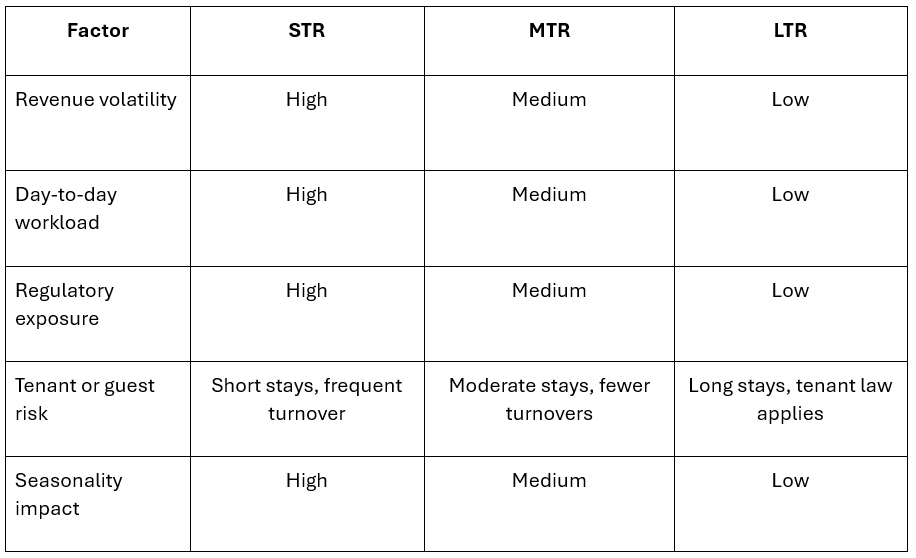
For many operators, this is not a permanent exit. It is a way to de-risk the asset, simplify operations, and keep future options open. You can always scale back up later if the market or regulations shift in your favor.
Exit Path #3: Scale Back Instead of Exiting (The “Keep the Upside, Lose the Stress” Option)
How to Scale Back Your STR Without Killing Cash Flow
Not every exit has to be all-or-nothing. In many cases, the smartest move is to scale back your short-term rental instead of shutting it down or selling outright. This approach lets you keep the upside of ownership while dialing down the parts of hosting that cause the most stress.
Here are the most effective ways experienced hosts scale back without blowing up cash flow.
1. Go Seasonal: Run Peak Months, Stabilize the Off-Season
If your market has clear high and low seasons, you don’t have to operate year-round.
Many hosts now run their STR only during peak demand months, then switch to a mid-term rental for the slower season. Think summer beach markets, ski towns, or festival-driven cities where demand drops hard part of the year.
This strategy works because:
- Peak months still generate the majority of your annual profit
- Mid-term tenants reduce turnover, cleaning, and guest communication
- You avoid discounting nightly rates just to stay booked
Seasonal operation also gives you built-in downtime, which is often what burned-out hosts actually need most.
2. Reduce Channels: Fewer Platforms, Fewer Turnovers
Being listed everywhere sounds smart, but it often creates more work than value.
Scaling back can be as simple as:
- Removing lower-performing platforms
- Increasing minimum stay requirements
- Eliminating last-minute bookings
Longer stays mean fewer check-ins, fewer cleanings, and fewer guest issues, all without a proportional drop in revenue. Many hosts find that going from two-night minimums to four or five nights cuts their workload in half while keeping most of their income intact.
The goal here is not maximum occupancy. It’s maximum sanity per dollar earned.
3. Outsource the Hardest Parts First
If hosting feels overwhelming, it’s usually because you’re doing everything yourself.
You don’t have to hand over the entire operation to scale back effectively. Start by outsourcing the pieces that drain the most energy.
Common first steps include:
- Hiring a co-host for guest messaging and issue handling
- Using a cleaning team with built-in restocking and inspections
- Outsourcing pricing to a dynamic pricing tool
Partial management keeps you involved at a high level while removing the constant interruptions that cause burnout.
4. Rebuild Systems Instead of Working Harder
Many STRs feel exhausting because they rely too much on the owner’s memory and availability.
Scaling back is the perfect time to tighten your systems:
- Create simple SOPs for cleaners, maintenance, and turnovers
- Automate pricing and guest messaging where possible
- Set a regular maintenance cadence instead of reacting to problems
Strong systems reduce decision fatigue and make the property easier to run, easier to hand off, and easier to sell later if you choose that path.
5. Scale-Back Triggers: When This Option Makes the Most Sense
Scaling back is usually the right move when:
- You are still profitable but mentally exhausted
- Local rules allow limited or conditional STR activity
- You want to preserve flexibility for a future sale or conversion
If your property works but you’re tired of being “on” all the time, scaling back lets you reset without giving up the asset entirely.
For many owners, this ends up being the most sustainable long-term strategy, not a temporary compromise.
Tax and Capital Strategies That Can Change Your Net Proceeds
Before you decide to sell, convert, or shut down an STR entirely, it’s worth looking at a few advanced levers that can dramatically change how much money you actually walk away with. These strategies are not for everyone, but for the right owner, they can mean keeping more capital, delaying taxes, or exiting without fully giving up the asset.
1. 1031 Exchange Basics for Short-Term Rental Owners
A 1031 exchange lets you sell an investment property and reinvest the proceeds into another “like-kind” property while deferring capital gains taxes. For Airbnb owners, the big question is usually whether a short-term rental even qualifies.
In many cases, it can. The IRS generally looks at intent and usage. A commonly referenced safe-harbor guideline is that the property is rented for at least 14 days per year and personal use is limited. While this doesn’t guarantee qualification, it’s often used as a baseline when discussing STR eligibility with tax professionals.
If your Airbnb meets investment use criteria, a 1031 exchange can allow you to:
- Sell a high-maintenance or regulation-exposed STR
- Reinvest into a more stable market or property type
- Scale up into a larger asset without triggering immediate taxes
Timing matters here. Exchanges have strict deadlines, and mistakes are expensive. This is where many investors bring in specialists, sometimes called “Tax Sharks,” who focus specifically on real estate tax strategy and exchanges.
2. Refinance or Cash-Out Refi as a Partial Exit
If your Airbnb still performs well but you want liquidity or less risk, refinancing can act as a partial exit. Instead of selling the property, you tap into the equity you’ve built and pull cash out while keeping ownership.
This approach can make sense if:
- You want to redeploy capital into another investment
- You believe the property still has long-term value
- You want to reduce pressure without triggering a taxable sale
The tradeoff is higher debt and monthly payments, so this only works when cash flow remains healthy. For some owners, this strategy buys time and flexibility while they decide on a longer-term exit.
3. Estate Planning and Long-Term Ownership Considerations
For owners thinking beyond the next sale, estate planning can also factor into an exit strategy. Holding a property long-term may allow heirs to receive a step-up in basis, potentially reducing capital gains taxes if they sell later.
This is highly personal and depends on family goals, asset mix, and tax exposure. It’s not something to DIY, but it’s worth discussing if your STR is a meaningful part of your net worth.
Important note: This section is for educational purposes only. It is not tax or legal advice. Always consult a qualified tax professional, CPA, or real estate attorney before making decisions involving exchanges, refinancing, or estate planning.
Special Case: Exiting Airbnb Arbitrage (Leasing, Not Owning)
Exiting an arbitrage unit starts with the lease, not the Airbnb listing. Review your lease for subletting or short-term rental language, any written permission from the landlord, and the notice or termination requirements. Do not assume silence means approval. If you need to exit early, it is usually better to communicate clearly and propose a clean move-out plan than to disappear and hope for the best.
Next, manage guest transitions early to avoid unnecessary cancellations. Stop new bookings right away by blocking your calendar, then review existing reservations by check-in date. When possible, honor near-term stays and address far-out bookings first. If you cannot host future guests, help them find alternatives or relocate them to another unit if you have one. Early communication gives you options and protects your reviews.
What is “allowed” in arbitrage usually hinges on two things: local rules and landlord permission. Even if your city allows short-term rentals, your lease may not. And even with landlord approval, local regulations can still apply. The cleanest exit aligns both sides, leaves the unit in good condition, and closes the door without legal or reputational fallout.
The Zero-Regrets Exit Plan: A 30-Day Exit Plan You Can Follow
Exiting an Airbnb does not have to feel rushed, emotional, or messy. Whether you are selling, converting, or simply pulling back, this 30-day plan helps you move deliberately and avoid decisions you regret later. Think of it as a reset month where you get clarity, clean things up, and execute with confidence.
Week 1: Run the Numbers, Check Regulations, Pick Your Path
Start with facts, not feelings.
Pull your last 12 to 24 months of performance and look at the basics. Occupancy, average nightly rate, total revenue, operating expenses, and true net profit after cleaning, maintenance, and management time. Be honest here. This is not about proving the Airbnb worked. It is about seeing what it looks like today.
Next, review your local rules. Check short-term rental ordinances, permit requirements, renewal dates, enforcement activity, and HOA or city updates. Even small regulatory changes can dramatically affect your risk going forward.
Once you have the financial and regulatory picture, choose a primary exit path:
- Sell the property
- Convert to a mid-term or long-term rental
- Scale back operations to reduce workload
Do not overthink it. Pick the option that best aligns with your goals, stress tolerance, and timeline. You can always adjust later, but clarity unlocks progress.
Week 2: Operational Cleanup and Documentation
This week is about making your property and your records easy to hand off.
Start with the operational side. Fix small issues you have been ignoring. Replace worn items, tighten up safety features, and refresh anything that looks tired. A clean, well-maintained property is easier to sell, easier to rent long term, and easier to step away from mentally.
Then get your documentation in order:
- Clean profit and loss statement
- Booking history and occupancy summaries
- List of recurring expenses and vendors
- Inventory of furniture and equipment
- Permits, licenses, insurance, and warranties
If you are selling, this makes your property more attractive and easier to evaluate. If you are converting or scaling back, it gives you a clear baseline so you can measure what changes after the exit.
Week 3: Execute the Exit Path
Now you act.
If you are selling, this is when you talk to agents or buyers, finalize pricing, and decide how to handle future bookings. You may block new reservations, wind down the listing, or prepare marketing materials focused on income history.
If you are converting to a mid-term or long-term rental, update the property for the new tenant type. Adjust pricing, write or review lease terms, decide how utilities are handled, and list the property on the right platforms.
If you are scaling back, simplify. Raise minimum stays, reduce platforms, limit peak-season operation, or delegate tasks that drain your time. The goal is to keep the upside while removing the friction.
This week may feel uncomfortable because it is the point of no return. That is normal. Stick to the plan you chose in Week 1.
Week 4: Handoff and Post-Exit Optimization
The final week is about closing the loop and setting yourself up for what comes next.
If you sold, complete the handoff cleanly. Transfer documentation, cancel services you no longer need, and take a moment to review the financial outcome. Then decide where that capital goes next, whether that is paying down debt, investing elsewhere, or simply building a buffer.
If you converted to a longer-term rental, focus on stabilization. Confirm rent collection, maintenance expectations, and communication systems. A smooth first month often determines whether the conversion feels like relief or regret.
If you scaled back, review the early results. Has your workload dropped? Is cash flow still acceptable? Make small adjustments now while everything is fresh.
The goal of this week is not just to exit, but to land well. A clean exit should reduce stress, improve clarity, and give you options instead of closing doors.
FAQs
When is the best time of year to sell an Airbnb?
For most markets, late spring through early summer is the strongest window. Buyer demand is higher, properties show better with peak-season performance, and recent revenue numbers look more attractive. That said, the best time to sell is really when your financials are clean and predictable. A well-documented, consistently performing Airbnb can sell well in any season, especially to another investor.
Can I sell my Airbnb listing, reviews, or Superhost status to a buyer?
No. Airbnb listings, reviews, and Superhost status are tied to the host account and cannot be transferred to a new owner. What you can sell is the property, the furnishings, and the business setup behind it. Many sellers help buyers by sharing performance data, SOPs, and vendor contacts, or by temporarily adding the buyer as a co-host during the transition so they can learn the systems.
Should I sell furnished or unfurnished?
In many cases, selling furnished makes the property more attractive to investors and short-term rental operators. Furnishings can reduce startup friction and help justify a higher price. That said, traditional homebuyers often prefer unfurnished homes. If you expect an owner-occupant buyer, selling unfurnished may widen your buyer pool. The right choice depends on whether you are targeting investors or retail buyers.
Is it better to convert to mid-term or long-term?
Mid-term rentals work well if your property is furnished and located near hospitals, military bases, or corporate hubs. They usually offer higher income than long-term rentals with less turnover than Airbnb. Long-term rentals provide the most stability and the least day-to-day involvement, but often at a lower monthly return. The better option depends on your local demand, your tolerance for management, and whether you want flexibility to return to short-term renting later.
What should I do with future bookings if I’m selling?
The cleanest option is to stop accepting new bookings as soon as you decide to sell by blocking your calendar or temporarily unlisting the property. Existing reservations can usually be honored before closing. If the buyer wants to continue operating as a short-term rental, some sellers coordinate a smooth handoff by timing the closing after the last stay or by helping the buyer relist quickly once ownership transfers.
Can a short-term rental qualify for a 1031 exchange?
Yes, in many cases a short-term rental can qualify for a 1031 exchange if it is primarily operated as an investment property. This generally means limiting personal use and showing that the property was held for income. Because 1031 rules are strict and highly fact-specific, it is important to work with a qualified tax professional before selling if you plan to defer capital gains using an exchange.
The Bottom Line
Every Airbnb reaches a crossroads. Selling, converting, or scaling back are all valid exit strategies, but the right choice depends on whether the issue is the property or the workload. Many hosts exit not because the numbers stopped working, but because managing guests, pricing, cleaning, and maintenance became exhausting.
Before you fully walk away, consider one more option: exiting the work without exiting the investment. Awning’s full-service property management is built for owners who want to keep the upside of short-term rentals without the daily involvement. Awning handles pricing, guest communication, operations, cleaning, and local compliance so your property runs like a business, not a second job.
If you are weighing an exit, partnering with Awning can help you stabilize performance now and preserve flexibility to sell or convert later. Sometimes the smartest Airbnb exit strategy is simply stepping out of the day-to-day.

%201.webp)
%203.webp)

%201.webp)
.webp)


